NEW OFFERING! Founder Brand Sprint - We launch your founder-led content machine in 3 weeks.
Business Fiction podcastFiction for B2B?!


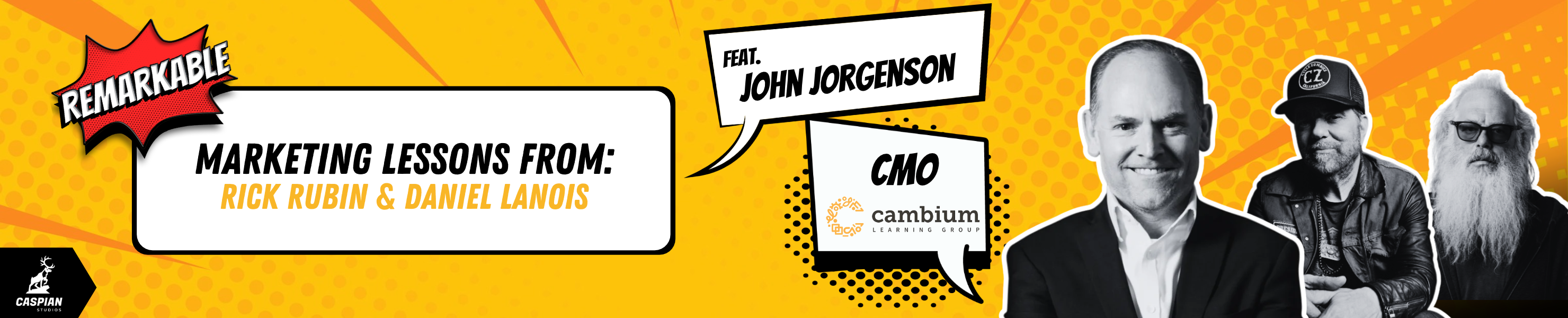
John Jorgenson, CMO at Cambium Learning Group, shares marketing lessons from music producers Rick Rubin and Daniel Lanois, including what it means to think like a producer, why being a reducer takes real confidence, how to protect original ideas from the committee, and why launching a brand is just the start of the conversation.
What if the most valuable thing you bring to your team isn't your expertise, but the environment you create?
Rick Rubin and Daniel Lanois make very different records. Lanois builds the room, recording in a Georgian house outside Dublin and a kitchen in New Orleans. Rubin clears everything away until only the emotion is left. John Jorgenson, CMO at Cambium Learning Group, says they are also two of the best leadership models a marketer could have.
Together we dig into what it means to think like a producer, why being a reducer takes real confidence, how to protect original ideas from the committee, and why launching a brand is just the start of the conversation.
About our guest, John Jorgenson
John Jorgenson is Chief Marketing Officer at Cambium Learning Group, an education technology portfolio company whose K-12 brands span literacy, data-driven assessment, and more. He joined in November 2019 to articulate the story behind what he calls the best-kept secret in ed tech, and to help each Cambium brand tell its own story as part of the whole. He describes his role as part creative and strategic brand leader, part consultative enabler. A longtime fan of Daniel Lanois and Rick Rubin, John read Rubin's book The Creative Act twice in preparation for this conversation.
Be a reducer: take out everything that isn't the point.
Rubin prefers the word reducer to producer, because he likes getting the point across with the least information possible. John says that is the idea he relates to most, and it applies to everything from an investor story to an emotional brand commercial. "It really is about being really clear on what it is you're trying to communicate and just making sure you're not compromising on that, and reducing down everything else so you don't lose it amongst all of the talking points and the data." The catch is that reducing takes confidence, and confidence takes time. "In order to be a reducer, you have to have confidence to know, you know what? If I take that out, that's not gonna ruin anything. It's just gonna make this other thing that's more important more prominent." For John, that confidence came from mentors, failures, and decades of experience, and it comes down to one thing: "I'm comfortable with me."
Protect original ideas from the vote to kill them.
The episode's best story is about System of a Down. The program director of a major LA rock station declared the band would never play on his station, and a year later it was the most requested band by his own audience. The lesson for marketers is that gatekeepers will tell you your audience won't like something, and the truth is nobody knows. As Ian puts it, the more people who get a vote to kill something, the more certain they are to kill it, because it is new and original. Ian's version of the same idea is the 14 people on a notes call, which turns a great idea into bland nothingness and is how you never get a song like "Chop Suey." John offers a Zen answer: a student asks a master for his secret and the master says, "My secret is that I don't mind what happens." Create the work you believe in, and trust that the people who need it will find it. And when a big branding project hits the late-stage moment where you hate all of it, John says that is part of the process, and a good sign.
Build the brand, ship the work, keep the conversation going.
John draws a sharp line between building a brand and building pipeline. "I'm not gonna grow a brand by selling more stuff to more people. I might grow a business, but that could easily be displaced by a new competitor and people suddenly have totally forgotten about you." He is not anti-ROI, and Ian adds that the best way to drive real revenue is often to make asymmetric bets at the top of the funnel rather than only optimizing conversion. But a conference booth's pipeline numbers, he says, never capture what the brand is really building. Then comes the discipline of shipping. Borrowing a line from Seth Godin, John says if you don't ship it, it doesn't exist, and perfection is not worth pursuing. And shipping is not the finish line. "When we say we are launching a brand, that's just the beginning. That's the beginning of the conversation." Like a musician who plays the same song on tour for 30 years, a brand keeps evolving long after launch day.
Think like a producer, not a conductor.
John is clear that he is not the artist, the designer, or the best writer on his team, and that is exactly the point. What he brings is the environment. "It really is about creating an environment and making sure that environment is rooted in an authentic sense of who I am, the beliefs that I have, the convictions I have, the things I really love. And then if I really prioritize those things, that makes everything possible." Ian pushes the idea further with a thought exercise: if Rick Rubin were a B2B CMO, he would find talented creative people, remove obstacles, get out of the way, and refuse to note them to death. John sees his own role at Cambium the same way, like a producer at a record label where every brand is its own artist. His advice for anyone early in their career is to start thinking this way now: "I shudder to think I ever have to be the smartest person in the room, because it will be a scary result if I think that I have all the answers."
This idea of thinking about yourself as a producer, because I think there's just so much more benefit from that than just having all the answers."
- John Jorgenson
Links
Connect with John on LinkedIn: https://www.linkedin.com/in/jjorgenson/
Learn more about Cambium Learning Group: https://www.cambiumlearning.com
About Remarkable!
Remarkable! is created by the team at Caspian Studios, the premier B2B Podcast-as-a-Service company. Caspian creates both nonfiction and fiction series for B2B companies. If you want a fiction series check out our new offering - The Business Thriller - Hollywood style storytelling for B2B. Learn more at CaspianStudios.com.
In today's episode, you heard from Ian Faison (CEO of Caspian Studios) and Meredith Gooderham (Head of Production). Remarkable was produced this week by Meredith Gooderham, edited by Jon Goldberg, and our theme song is "Solomon" by FALAK.
Create something remarkable. Rise above the noise.